
This post may contain affiliate links. See our disclosure.
How to Build an Emergency Fund (When Money's Already Tight)
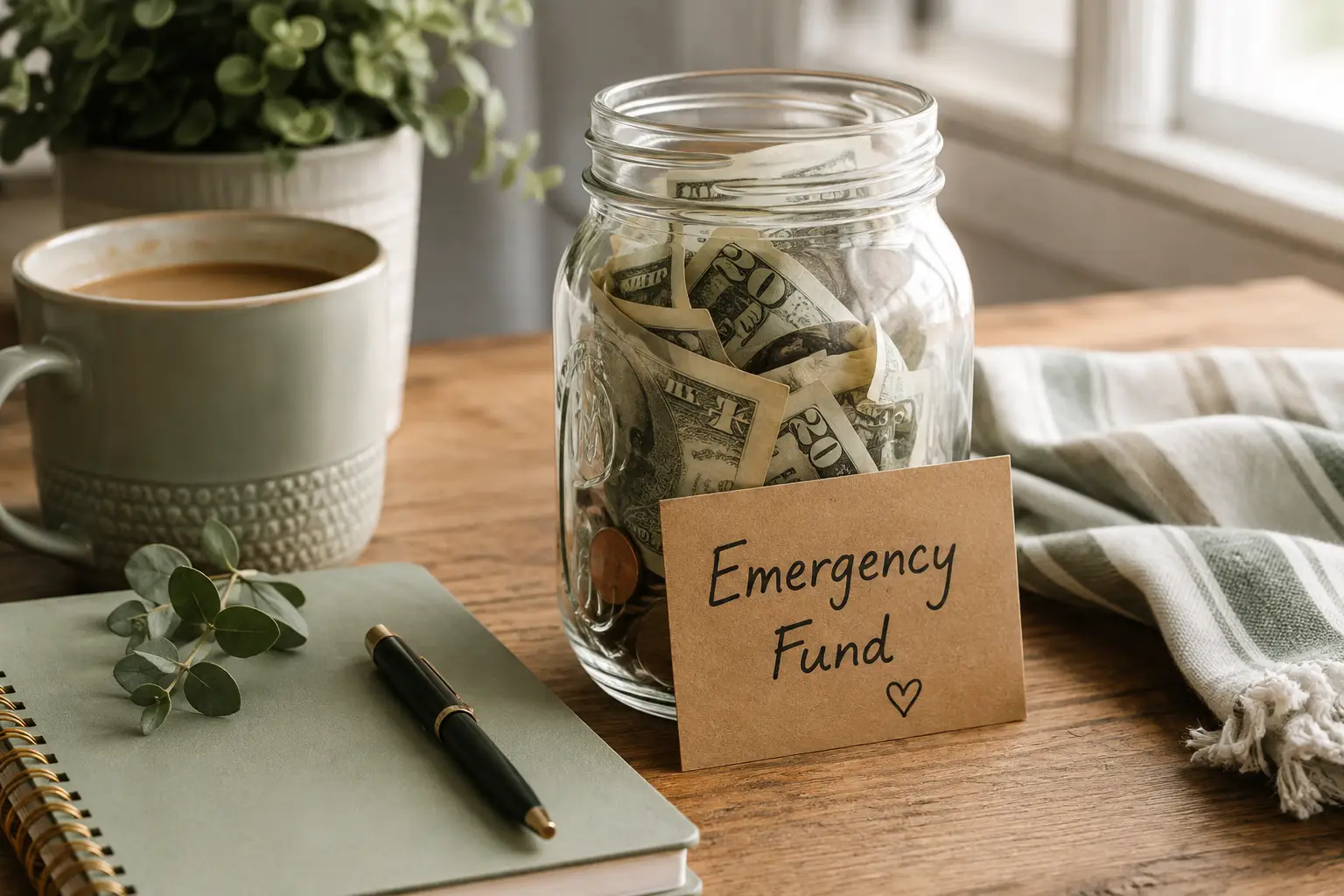
An emergency fund sounds like something you build once your budget has "extra" room — which is exactly why so many people never start one. If you're living paycheck to paycheck, the idea of setting aside three to six months of expenses can feel less like helpful advice and more like a joke. Here's the realistic version: how to start an emergency fund from wherever you actually are right now, with a real first target that isn't three to six months of anything.
This post contains affiliate links. If you purchase through one, PennyBloom may earn a small commission at no extra cost to you. See our full disclosure for details.
Why an Emergency Fund Matters More Than It Sounds
An emergency fund isn't about being pessimistic — it's about breaking a specific, expensive cycle: unexpected expense → credit card → minimum payments → interest → less room in next month's budget → the next unexpected expense lands on the card again. A car repair, a broken appliance, or a smaller-than-usual paycheck shouldn't have the power to undo months of financial progress. That's the entire job of an emergency fund: it turns a crisis into an inconvenience.
Without one, even a well-run budget stays fragile. With even a small one, a $300 car repair becomes "I'll transfer that back into savings next month" instead of "I'm carrying a new balance at 24% interest."
How Much Do You Actually Need?
This is where most advice stops being useful, because "3-6 months of expenses" is true but not a place to start. Think of it in two stages instead:
Stage 1 — The starter fund: $500-$1,000. This single stage prevents the majority of small emergencies (a flat tire, a vet bill, a broken phone screen) from becoming debt. It's a realistic first target from almost any income.
Stage 2 — The full fund: 3-6 months of essential expenses. "Essential" means rent, utilities, groceries, insurance, and minimum debt payments — not your full current spending. This stage takes most people well over a year to reach, and that's normal, not a failure.
| Household situation | Suggested target |
|---|---|
| Single income, stable job | 3 months of essential expenses |
| Single income, variable/gig income | 6 months of essential expenses |
| Dual income, both stable | 3 months (can split the risk) |
| Dependents relying on your income | Toward the higher end of your range |
Your number doesn't need to be perfect on day one — it needs to be a real number you're working toward instead of an abstract "someday" goal.
A Realistic Timeline: Reaching Your First $500
Seeing the math laid out tends to make $500 feel a lot less abstract than it sounds as a lump sum:
| Weekly contribution | Time to reach $500 |
|---|---|
| $10/week | ~50 weeks (about a year) |
| $20/week | ~25 weeks (about 6 months) |
| $35/week | ~14 weeks (about 3.5 months) |
| $50/week | 10 weeks (about 2.5 months) |
None of these paces are "wrong." A year to reach $500 while also paying rent, keeping the lights on, and covering groceries is still a year in which you went from zero emergency cushion to a real one — that's the actual win, regardless of which row fits your budget right now.
The "Money's Already Tight" Reality Check
If you're reading this while wondering where $500 would even come from, you're the exact person this guide is for — not someone this guide assumes doesn't exist. A few things worth saying plainly:
- Starting small isn't failing. A $5/week emergency fund is still an emergency fund. It's the habit that matters first, not the dollar amount.
- You don't need to hit Stage 2 to benefit. Even $200-300 saved changes what happens the next time something breaks.
- This runs alongside your other financial priorities, not after them. You don't need to "finish" budgeting or debt payoff before starting — a small emergency fund actually makes those other efforts more stable.
Where to Find Money When There's Nothing Obvious Left Over
This is usually the real question, not "how much do I need." A few places people overlook:
- Run your numbers through a budget framework first. If you haven't sorted your spending into needs, wants, and savings, you may be overestimating how tight things really are. The 50/30/20 rule is a fast way to see where your money is actually going before assuming there's nothing left.
- Redirect one specific recurring cost. Not "cut spending" in general — pick one subscription, one recurring delivery fee, or one habit purchase and redirect exactly that amount, automatically, the day it would have been spent.
- Use windfalls on purpose. Tax refunds, rebates, cashback, a birthday gift of cash — instead of letting these absorb into regular spending, decide in advance that windfalls go straight to the starter fund until it's full.
- Shrink your biggest flexible expense. For most households, that's groceries. A realistic $200/month grocery reduction fully funds a $500 starter emergency fund in about ten weeks on its own.
- Sell something you're not using. A one-time transfer from selling unused items can jump-start the fund without touching your monthly cash flow at all.
- Round-up or micro-transfer if your bank offers it. Small amounts you'll barely notice add up faster than they feel like they should.
The Starter Emergency Fund Method
- Pick your number. $500 is a strong default; $1,000 if your situation is more variable (gig work, irregular hours).
- Open a separate account. Keeping the fund physically separate from checking is the single biggest predictor of whether people actually keep it intact — "out of sight" really does work.
- Automate a small, boring amount. $10-25/week is enough to reach $500 in 4-12 weeks. Boring and automatic beats ambitious and manual.
- Add every windfall until it's full. Tax refund, rebate, cashback — all of it, until Stage 1 is complete.
- Stop and redirect once you hit your number. At $500-$1,000, shift new contributions toward debt payoff or Stage 2 savings — the starter fund has done its job.
Emergency Fund vs. Paying Off Debt: Which Comes First?
This is one of the most common points of confusion, and the honest answer is: a little of both, in sequence.
- First, build the $500-$1,000 starter fund — even while carrying debt. Without it, the next emergency just becomes new debt, which cancels out payoff progress.
- Then, prioritize high-interest debt. Whether you use the snowball or avalanche method, this is usually the highest-value use of extra money once the starter fund exists, since credit card interest rates typically beat what a savings account earns by a wide margin.
- Finally, build toward the full 3-6 month fund, often while still making minimum payments on lower-interest debt (student loans, an auto loan) in the background.
Skipping straight to aggressive debt payoff with zero safety net is the most common way people end up back in debt within a year of paying it off.
Building Past the Starter Fund
Once Stage 1 is done, Stage 2 is really just "more of the same system, for longer":
- Automate a consistent transfer, even if it's modest. Consistency over years matters more than the dollar amount in any given month.
- Increase it when your income increases. A raise or bonus is an easy moment to bump your automatic transfer before the extra money becomes normal spending.
- Treat it like a real bill, not a leftover. Money you save "if there's anything left" tends to stay at zero indefinitely.
- Recheck your target periodically. A new dependent, a less stable job, or a move to a higher cost-of-living area all change what "3-6 months" actually means in dollars.
Where to Keep the Money
A high-yield savings account (HYSA) at an online bank is the right home for both stages of your emergency fund:
- Separate from everyday spending, so it stays "out of sight, out of mind"
- Usually no minimum balance to open
- Earns meaningfully more interest than a traditional brick-and-mortar savings account
- Still liquid — accessible within a day or two, unlike money locked in a CD or invested in the market
Investing your emergency fund isn't recommended — the entire point is that it's there, at full value, exactly when you need it, even if the market happens to be down that week.
What Counts as a Real Emergency (and What Doesn't)
A quick gut-check before you dip into the fund:
Real emergencies: job loss, a necessary car repair to get to work, an unexpected medical bill, an essential home repair (like a broken furnace in winter).
Not emergencies: a sale ending soon, a vacation, a predictable annual expense you didn't plan for (holidays happen every year — that's a sinking fund, not an emergency), or general overspending in a given month.
If you do have to dip in, that's the fund working exactly as designed — the only real mistake is not refilling it afterward.
Emergency Fund vs. Sinking Fund: Don't Confuse the Two
These get mixed up constantly, and mixing them up is how emergency funds end up drained on things that were never really emergencies. An emergency fund covers the unplanned and unpredictable: the things you genuinely couldn't have seen coming. A sinking fund covers the planned and predictable: expenses you know are coming, just not this exact week — holiday spending, an annual insurance premium, a birthday, a car registration renewal. Both matter, but they solve different problems. If your "emergency" fund keeps getting spent every December, the actual gap in your system is a missing sinking fund for holidays, not a failure of your emergency savings. Keeping them as separate, clearly labeled accounts (even if both are small right now) prevents this exact mix-up before it starts.
Common Mistakes
- Waiting for "enough extra" to start. There's rarely a month that feels like the right time — starting with $5-10/week beats waiting for a month that never quite arrives.
- Keeping it too accessible. In your checking account, it quietly gets spent on non-emergencies. Separate accounts create just enough friction to protect it.
- Skipping Stage 1 to chase Stage 2. A half-funded 3-6 month goal that still leaves you exposed to small emergencies is often less useful than a fully-funded $500 starter fund.
- Treating a dip as a failure. Using the fund for an actual emergency is success, not a setback — refill it and move on.
Frequently Asked Questions
How much emergency fund do I actually need? Start with a $500-$1,000 starter fund to cover small, common emergencies. Once your high-interest debt is under control, build toward 3-6 months of essential expenses. The exact number depends on your job stability and how many people depend on your income.
How do I build an emergency fund on a low income? Start smaller than feels meaningful — even $5-10 a week builds the habit. Automate a tiny transfer right after payday, use windfalls (tax refunds, rebates) to jump-start the fund, and treat the starter goal as $500, not the full 3-6 months, until your situation changes.
Should I pay off debt or build an emergency fund first? Most plans recommend a small starter fund ($500-$1,000) before aggressive debt payoff, so an unexpected expense doesn't become new credit card debt. After that starter fund exists, many people split extra money between debt payoff and continuing to grow savings.
Where should I keep my emergency fund? A high-yield savings account at an online bank — separate from your everyday checking account so you're not tempted to dip into it, but still liquid enough to access within a day or two when a real emergency hits.
Try It With Your Own Numbers
Not sure how much room your budget actually has for a starter fund? Run your take-home pay through the PennyBloom Budget Calculator — it splits your income into needs, wants, and savings so you can see exactly where a weekly emergency-fund transfer fits, free and with no signup required.
Keep reading:
- The 50/30/20 Rule for Beginners — find the room in your budget to start your starter fund
- The 52-Week Savings Challenge — a structured, game-like way to build your emergency fund week by week
- How to Cut Your Grocery Bill — free up $200/month to fund your starter goal in about ten weeks
Not sure where your paycheck should go?
Try the free 50/30/20 calculatorPennyBloom Team
Sharing practical, judgment-free money tips for real American families.
Get free budgeting tips + printables in your inbox
Join thousands of readers getting practical money tips every week. No spam, ever.
Related reads

The 50/30/20 Rule for Beginners: A Simple Way to Finally Budget
New to budgeting? Here's the 50/30/20 rule explained in plain English, with real dollar examples at three income levels and a free calculator to try it yourself.
8 min read
The 52-Week Savings Challenge: How to Actually Finish It This Year
The classic 52-week savings challenge, the reverse version, and a low-income-friendly variant — plus a free printable chart to track your progress week by week.
7 min read
How to Cut Your Grocery Bill by $200 a Month (Without Coupon-Clipping for Hours)
A realistic, stacked system for cutting your grocery bill by around $200 a month — price tracking, meal planning that actually sticks, and smart pantry stockpiling.
7 min read