
This post may contain affiliate links. See our disclosure.
The No-Spend Challenge: Rules, Tips, and a 30-Day Plan
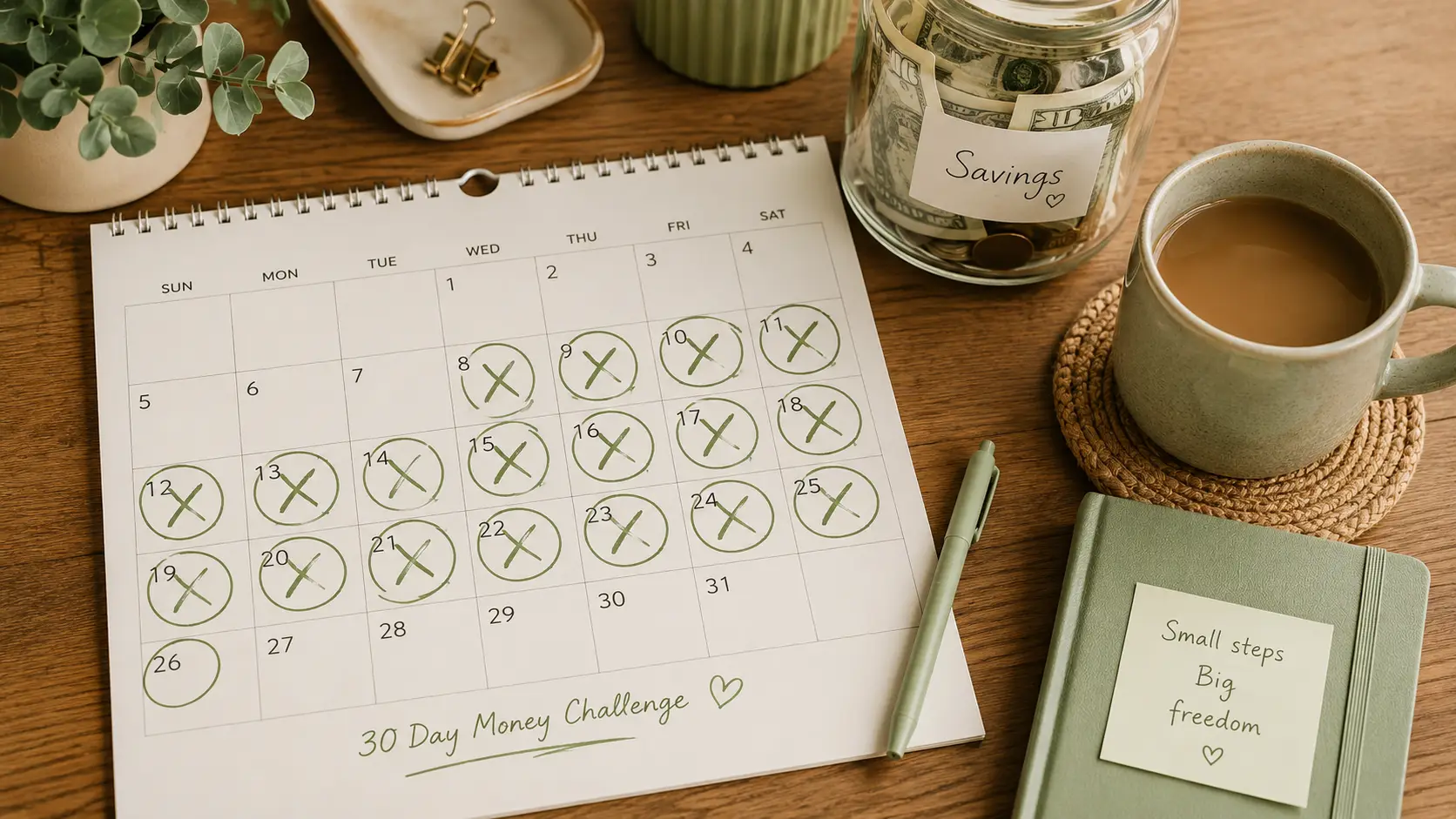
A no-spend challenge sounds simple — just don't spend money for 30 days — right up until day three, when you realize how much of your normal spending happens on autopilot. That's actually the point. This isn't about punishing yourself; it's a short, structured reset that shows you exactly where your money goes when you're paying attention, plus a real plan for making it 30 days instead of quitting on day six.
This post contains affiliate links. If you purchase through one, PennyBloom may earn a small commission at no extra cost to you. See our full disclosure for details.
What a No-Spend Challenge Actually Is
The core idea: pick a time period (commonly 30 days, though a week or a full "no-buy year" both exist), define what counts as essential spending, and commit to spending only within that essential list for the duration. Everything outside it — the impulse buys, the "just this once" takeout, the browsing-turned-purchasing — gets paused, not eliminated forever.
It's less a punishment and more a diagnostic tool. Most people don't actually know where their discretionary money goes until they try to stop spending it for a month and notice exactly how often the urge shows up.
The Rules That Make It Work (Instead of Feeling Miserable)
The single biggest reason no-spend challenges fail isn't lack of willpower — it's rules that were never realistic to begin with. A workable rule set typically looks like this:
Still allowed (essentials):
- Rent or mortgage
- Utilities and phone/internet
- Groceries (actual grocery spending, not takeout)
- Minimum payments on all debt
- Medical necessities and prescriptions
- Gas/transportation needed for work
- Anything already paid for or scheduled before the challenge started
Paused for the duration:
- Dining out and takeout
- Discretionary shopping (clothes, gadgets, home décor)
- Entertainment subscriptions beyond what you decide is essential
- Impulse purchases of any kind
- "Treat yourself" spending — coffee runs, small daily purchases that add up
The exact line is yours to draw. A parent might keep kids' activities in the "allowed" column; someone else might pause everything except the strict essentials. What matters isn't matching someone else's rules exactly — it's deciding your own rules in advance, in a clear-headed moment, rather than negotiating with yourself mid-challenge when the urge to spend actually shows up.
Choosing Your No-Spend Level
Not every no-spend challenge needs to be maximally strict. Three common versions:
- Full no-spend. Only true essentials, nothing else, for the full period. The most dramatic reset, but also the hardest to sustain for people newer to intentional budgeting.
- Modified no-spend. Essentials plus one or two pre-approved categories (say, a monthly haircut or a specific hobby). Easier to sustain, still highly effective at cutting the biggest leaks.
- Category-specific no-spend. Instead of everything, target one problem area — no dining out, no online shopping, no new clothes — while normal spending continues elsewhere. A good starting point if a full challenge feels too extreme right now.
If you've never done one of these before, starting with a category-specific or modified version and succeeding is far more valuable than attempting the strictest version and abandoning it by day 10.
The 30-Day Plan
Structuring the month in phases makes the challenge feel manageable instead of like one long, undifferentiated stretch of deprivation:
| Week | Focus |
|---|---|
| Week 1 (Days 1-7) | Set your rules in writing, tell one accountability person, and notice — without judgment — every urge to spend outside the rules |
| Week 2 (Days 8-14) | The hardest stretch for most people — novelty has worn off, habit isn't automatic yet. Lean on substitutes: a walk instead of a shopping trip, cooking instead of ordering |
| Week 3 (Days 15-21) | Momentum typically builds here. Check your running savings total to reinforce that the challenge is working, not just restricting |
| Week 4 (Days 22-30) | Plan how the saved money gets used before day 30 arrives, so it doesn't just quietly re-absorb into normal spending the moment the challenge ends |
What a No-Spend Day Actually Looks Like
The idea can feel abstract until you picture an ordinary day inside it. Take a typical Tuesday: instead of grabbing coffee on the way to work, you make it at home — a five-minute habit shift that used to feel like a sacrifice by day 3 and feels completely normal by day 15. Lunch is packed instead of ordered, because groceries are still an allowed essential and takeout isn't. After work, the usual "quick stop" at the store to browse turns into a walk instead, partly because there's nowhere to spend money on a walk and partly because it turns out to be a genuinely better way to decompress. Dinner is something already in the pantry, which — a few days in — starts to feel less like deprivation and more like a small daily win you're tracking on purpose.
None of these individual swaps feel dramatic. That's exactly why the challenge works: it's not one big act of willpower, it's roughly thirty small ones, repeated until a few of them stick around even after the 30 days end.
No-Spend Challenge vs. Just Budgeting: Why Bother With Both
If you already track a budget, a no-spend challenge can feel redundant at first — isn't the whole point of a budget to control spending? The two actually solve different problems:
- A budget sets ongoing limits you're meant to live within indefinitely. It's built for sustainability, which means it usually allows some discretionary spending every month by design.
- A no-spend challenge is a short, intense reset — not a permanent lifestyle. It's designed to surface habits a normal budget doesn't catch, because a monthly "Wants" line item doesn't tell you which purchases were genuinely wanted versus automatic.
Most people get the most value from running a no-spend challenge occasionally — once or twice a year, or whenever spending has quietly crept up — rather than trying to live in "challenge mode" permanently. Think of your budget as the year-round system and the no-spend month as a periodic tune-up that resets habits the budget alone doesn't fully control.
What Counts as a "Free Pass" Exception
Real life doesn't pause for a challenge, and treating every exception as a total failure is how people quit entirely instead of adjusting. Reasonable, pre-decided exceptions might include:
- A gift you're obligated to buy (a wedding, a baby shower) that was already on the calendar
- A genuine home or car repair that can't wait
- A medical need that comes up mid-challenge
- Something already paid for before day 1 (a subscription renewal you forgot to cancel in time, for instance)
The key word is pre-decided. Deciding your exception categories before the challenge starts prevents "just this once" from becoming a daily loophole once temptation actually shows up.
Where the Savings Should Go
A no-spend month that saves real money but has no destination for it tends to just quietly get reabsorbed into normal spending the following month. Decide the destination before day 1:
- Straight into your emergency fund if your starter fund isn't fully built yet — a no-spend month is one of the fastest ways to hit a $500 starter goal in a single push.
- Into a specific sinking fund if you have an upcoming known expense (holidays, an annual bill) that could use a head start.
- Toward extra debt payments if that's your current priority — redirecting a month of discretionary spending straight at a high-interest balance can meaningfully shorten a payoff timeline.
Whatever you choose, transfer the money out of your checking account as soon as the challenge ends, before it has a chance to blend back into regular spending.
Handling Social Pressure Mid-Challenge
The hardest moments usually aren't solitary temptation — they're social. A coworker suggests lunch out, a friend invites you to a paid event, a family gathering has an unspoken expectation of chipping in for something. A few ways to handle it without either breaking the challenge or becoming impossible to be around for a month:
- Say the plan out loud, briefly. "I'm doing a no-spend month, want to grab a walk instead?" gets an easier response than most people expect, and often invites the other person to suggest a free alternative themselves.
- Suggest the free version of the same plan. Coffee at home instead of a café meet-up, a potluck instead of a restaurant, a walk instead of a shopping trip — the social connection stays intact even when the spending doesn't happen.
- Decide your line on group events in advance. If a friend's birthday dinner is already on the calendar, decide before the month starts whether that's an allowed exception rather than negotiating it in the moment, which is when willpower is weakest.
Common Mistakes That Sink a No-Spend Challenge
- Rules that are too strict to actually follow. A rule set so extreme it guarantees failure within a week isn't a real plan — it's a setup for giving up entirely.
- No plan for social situations. Friends' birthdays, group dinners, and family events don't pause for your challenge — decide in advance how you'll navigate them instead of improvising in the moment.
- Treating one slip as total failure. Breaking a rule on day 12 doesn't erase days 1-11. Note it, adjust if needed, and keep going.
- No destination for the savings. Without a plan for where the money goes, a successful challenge can still end with nothing to show for it a month later.
- Doing it alone with zero accountability. Telling even one other person meaningfully increases follow-through compared to a private, unspoken commitment.
Tips for Actually Finishing
- Write your rules down before day 1. A rule you have to invent mid-challenge is a rule you'll bend in the moment it's tested.
- Track your would-be spending, not just your actual spending. Noting what you would have bought (and its price) makes the total savings feel real and keeps motivation visible.
- Substitute, don't just restrict. Replace the habit, not just remove it — a walk instead of a shopping trip, a home-cooked meal instead of delivery.
- Revisit your "why" mid-month. Whatever prompted the challenge — a specific savings goal, breaking an impulse-spending pattern — write it somewhere visible for the harder days.
- Plan your first post-challenge purchase deliberately. Ending abruptly into unrestricted spending can undo the reset fast; ease back in with intention instead.
Frequently Asked Questions
What is a no-spend challenge? A no-spend challenge is a set period — commonly 30 days — where you commit to spending only on essential, pre-approved categories (like rent, groceries, and bills) and cut out everything else. It's designed to reset spending habits and reveal how much of your regular spending is automatic rather than intentional.
What are the rules for a no-spend month? Rules vary by household, but most versions allow rent/mortgage, utilities, groceries, minimum debt payments, and medical necessities, while cutting out dining out, subscriptions beyond the essentials, entertainment, and discretionary shopping. The specific line is up to you — the key is deciding it in advance, not in the moment.
What's the difference between a no-spend challenge and a no-buy month? They're often used interchangeably, but "no-buy" sometimes refers specifically to not purchasing new physical items (clothes, gadgets, home goods) while still allowing normal spending on services and experiences. A full no-spend challenge is usually stricter, cutting both purchases and most discretionary spending.
What happens if I break the rules during a no-spend challenge? One slip doesn't mean starting over or quitting. Note what happened, why, and what triggered it, then continue the challenge from that point forward. The goal is building awareness of your spending patterns, not achieving a flawless record.
See Exactly What You're Saving
Curious how much room a no-spend month actually opens up in your budget? Run your take-home pay through the PennyBloom Budget Calculator first to see your current Wants spending — that's the bucket a no-spend challenge is really targeting.
Keep reading:
- How to Cut Your Grocery Bill — a lighter-touch system if a full no-spend month feels too extreme right now
- How to Build an Emergency Fund — a natural destination for whatever you save during your no-spend month
- The 50/30/20 Rule for Beginners — see exactly how much of your budget is Wants before you start
Not sure where your paycheck should go?
Try the free 50/30/20 calculatorPennyBloom Team
Sharing practical, judgment-free money tips for real American families.
Get free budgeting tips + printables in your inbox
Join thousands of readers getting practical money tips every week. No spam, ever.
Related reads

How to Cut Your Grocery Bill by $200 a Month (Without Coupon-Clipping for Hours)
A realistic, stacked system for cutting your grocery bill by around $200 a month — price tracking, meal planning that actually sticks, and smart pantry stockpiling.
7 min read
How to Build an Emergency Fund (When Money's Already Tight)
A realistic, step-by-step guide to starting and growing an emergency fund on any income — even when there's nothing obvious left over each month.
11 min read
The 50/30/20 Rule for Beginners: A Simple Way to Finally Budget
New to budgeting? Here's the 50/30/20 rule explained in plain English, with real dollar examples at three income levels and a free calculator to try it yourself.
8 min read